
美姐
China's earliest tinned iron armor found in Zhejiang: 1,700-year-old anti-rust tech revealed_我的网站

A |
受今年第12号台风“梅花”影响,中国南方航空根据台风天气实际影响及时调整航班计划,截至目前,计划取消9月13日南航在上海虹桥机场、浦东机场共计25个进出港航班;计划取消9月14日在上海虹桥机场、浦东机场11个进出港航班。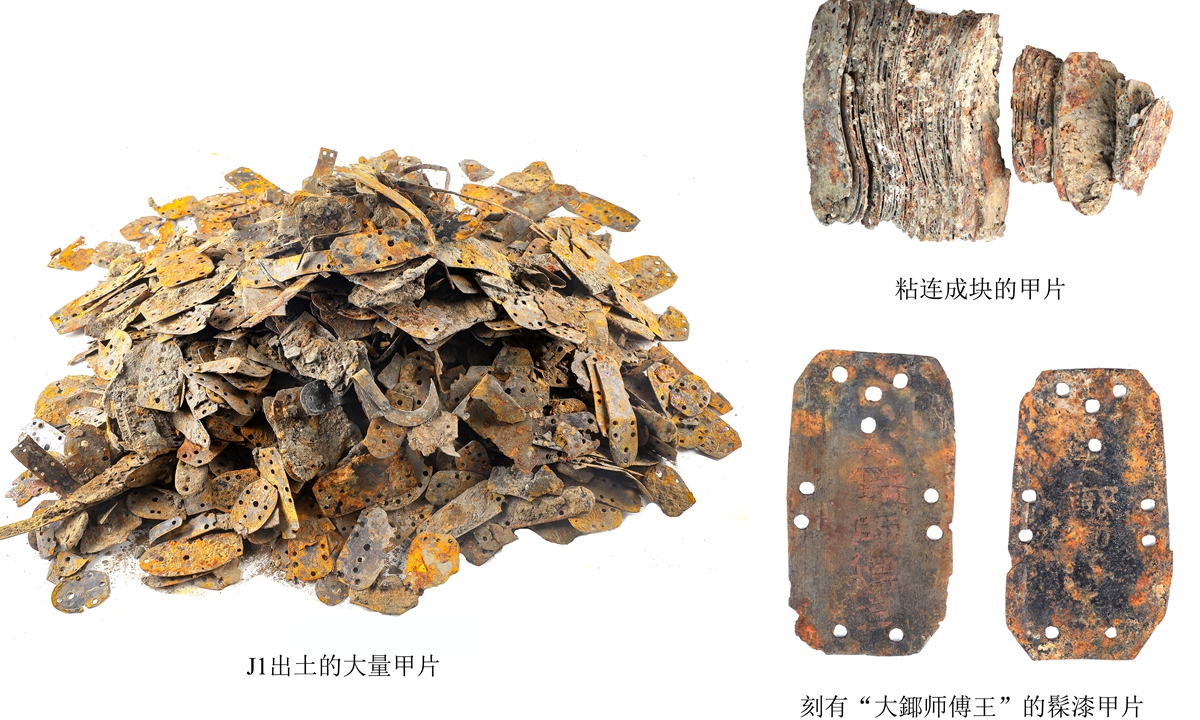
While China has a long history of making tinned bronze and tinware, there has long been a lack of reliable historical records or physical evidence to prove early local production of tinned iron artifacts. The newly discovered armor plates can fill this gap, demonstrating that, by no later than the Wu period, local craftspeople in Zhejiang Province had mastered the art of tin-plating iron surfaces. This reflects the region's advanced metallurgical skills at that time, Ge Shuaikun, a researcher at the Shaoxing Institute of Cultural Relics and Archaeology, told the Global Times on Tuesday.
Over the last three years, archaeologists working at the Jizhong ruins site have excavated hundreds of tinned iron armor plates from ancient wells and ash pits. A preliminary investigation confirmed that the surfaces of these plates contain high levels of tin. Subsequent laboratory analyses were conducted in collaboration with the Shaoxing's institute and the Institute for Cultural Heritage and History of Science & Technology at the University of Science and Technology Beijing with methods such as Scanning Electron Microscopy with Energy Dispersive Spectroscopy (SEM-EDS), X-ray Diffraction (XRD), and Micro-CT to deeply examine the samples' materials, structures, and technological traces.
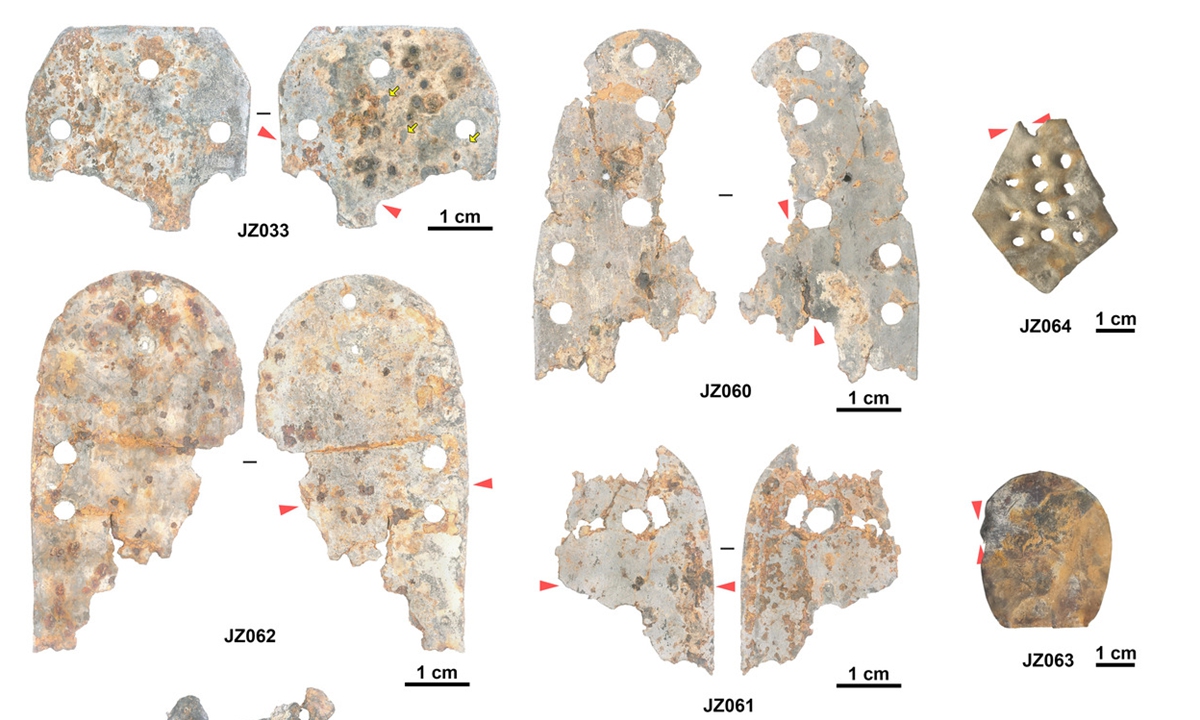
Research shows that the craftspeople immersed iron armor plates in molten tin, thus ensuring complete coverage of the surface with a continuous tinned layer. This coating isolated the iron from exposure to air and moisture, dramatically boosting corrosion resistance. Many of the excavated tinned armor pieces still show a clear, bright silver-white finish.
One major reason for tin-plating the armor was to prevent rust. At the same time, the silvery white shine of tinned iron offered a more striking, beautiful appearance, standing out from the typical dark iron armor of the era. This visual distinction may have marked these pieces as a higher-grade military asset, according to an article from the University of Science and Technology Beijing's official website.
The article said that in earlier eras, from the pre-Qin to Han dynasties, tin was widely used as a surface coating on bronzeware and ceramics. Researchers believe the tin-plating of iron armor discovered at the Jizhong ruins site during the Wu period of Three Kingdoms built upon this local tin-coating tradition, representing an adaptation of those techniques across different materials. The process likely benefited from technological exchange among various specialized workshops at the site, including those making bronze castings, iron weapons, and other metallurgical products.
。
。
B |
While China has a long history of making tinned bronze and tinware, there has long been a lack of reliable historical records or physical evidence to prove early local production of tinned iron artifacts. The newly discovered armor plates can fill this gap, demonstrating that, by no later than the Wu period, local craftspeople in Zhejiang Province had mastered the art of tin-plating iron surfaces. This reflects the region's advanced metallurgical skills at that time, Ge Shuaikun, a researcher at the Shaoxing Institute of Cultural Relics and Archaeology, told the Global Times on Tuesday.
Over the last three years, archaeologists working at the Jizhong ruins site have excavated hundreds of tinned iron armor plates from ancient wells and ash pits. A preliminary investigation confirmed that the surfaces of these plates contain high levels of tin. Subsequent laboratory analyses were conducted in collaboration with the Shaoxing's institute and the Institute for Cultural Heritage and History of Science & Technology at the University of Science and Technology Beijing with methods such as Scanning Electron Microscopy with Energy Dispersive Spectroscopy (SEM-EDS), X-ray Diffraction (XRD), and Micro-CT to deeply examine the samples' materials, structures, and technological traces.
Research shows that the craftspeople immersed iron armor plates in molten tin, thus ensuring complete coverage of the surface with a continuous tinned layer. This coating isolated the iron from exposure to air and moisture, dramatically boosting corrosion resistance. Many of the excavated tinned armor pieces still show a clear, bright silver-white finish.
One major reason for tin-plating the armor was to prevent rust. At the same time, the silvery white shine of tinned iron offered a more striking, beautiful appearance, standing out from the typical dark iron armor of the era. This visual distinction may have marked these pieces as a higher-grade military asset, according to an article from the University of Science and Technology Beijing's official website.
The article said that in earlier eras, from the pre-Qin to Han dynasties, tin was widely used as a surface coating on bronzeware and ceramics. Researchers believe the tin-plating of iron armor discovered at the Jizhong ruins site during the Wu period of Three Kingdoms built upon this local tin-coating tradition, representing an adaptation of those techniques across different materials. The process likely benefited from technological exchange among various specialized workshops at the site, including those making bronze castings, iron weapons, and other metallurgical products.
。

C | 据了解,9月13日,南航计划在虹桥机场取消的主要有CZ3572(虹桥—广州)、CZ6584(虹桥—深圳)等12个进出港航班;计划在浦东机场取消的主要有CZ3836(浦东—三亚)、CZ3544(浦东—武汉)等13个进出港航班。

D | 南航计划取消 9月14日15点至9月15日14点期间所有虹桥进出港航班,取消9月14日10点至9月15日14点期间所有浦东进港航班,取消9月14日12点至9月15日14点期间所有浦东出港航班。

E | 截至目前,9月15日在虹桥机场已取消的有CZ3966(虹桥—深圳)、CZ3552(虹桥—深圳)等4个进出港航班;计划在浦东机场已取消的有CZ6524(浦东—大连)、CZ6258(浦东—哈尔滨)等7个进出港航班。

F | (总台央视记者 郭臻)
Current article:http://yhd6g.caihezhehuagenshun.sbs/news/20260826_815.html
Published on:09:45:23
我的网站最新文章
- Ganesh Chaturthi 2025 Images: ये हैं गणेश चतुर्थी के खूबसूरत फोटोज, अपनों को भेजकर करें विश
- 奥克兰男子的昂贵自行车被盗,提供监控照片及GPS数据后警方拒绝进行调查
- 泽连斯基:乌克兰尚不具备战时选举条件
- 乒乓球常规挑战赛突尼斯站:中国队收获两项冠军
- 投资房产,他们全款买房为收租
- 'मैं राष्ट्रपति बनने को तैयार अगर...', अमेरिका के उपराष्ट्रपति जेडी वेंस ने ट्रंप को लेकर क्या कहा?
- 住宿怎么订更便宜?什么时候订酒店最便宜?实测酒店民宿省钱攻略+避坑技巧+优惠渠道推荐,全指南
- 2018年,中国的应用程序下载量占世界总下载量的50%,耗资近404亿美元。
- Chinese-built highway opens ahead of schedule in Senegal
- 国内洗碗机智能化能力评价有了统一技术规范,国内洗碗机智能化能力评价有了统一技术规范
- 中国牵头制定的全球电子通信磁性元件检测领域统一技术规范发布,中国牵头制定的全球电子通信磁性元件检测领域统一技术规范发布
- 科尔:我们的防守很出色 在客场把一支出色球队限制到只拿85分
- 开盘暴涨超240%!中一签赚超7.3万元!又见新股狂飙
我的网站随机推荐
- 市委组织部召开机关干部大会 宣布省委及市委关于市委有关领导同志任职的决定
- 治皮肤问题脸霜含类固醇 卫生科学局:近两年越来越多
- 菜篮子“轻了”,蛋袋子“微沉”,开学季是主因
- 第十三届哈尔滨朝鲜族民俗文化展演举行
- 魔兽争霸3:复制打开官方网站预约:经典作品,回归国王
- 探索“文旅+”的无限可能
- 福州优化不动产登记服务网点布局
- 从一穷二白到重器在手!人民海军,生日快乐!
- 深圳市解除暴雨黄色预警信号、解除雷电预警信号
- Meta压缩成本殃及大巴司机:班车供应商大幅裁员
- Graphic New Footage Shows Uvalde Police Waiting Inside Hallway for 77 Minutes During Shooting
- 7月底正式上市 搭载第五代DM混动技术 比亚迪海狮06 DM-i申报信息
- 雄安建设者拍雄安|亲子足球 火热开赛